
Utah County Property Records
Utah County property records are kept by the County Recorder at 100 East Center Street in Provo. The office serves one of Utah's fastest-growing counties and handles a high volume of deeds, mortgages, liens, subdivision plats, and GIS mapping requests each year. Whether you need to confirm ownership, find a recorded lien, or trace a chain of title, Utah County offers both online search tools and in-person access at the Provo courthouse. This guide covers every major office and resource involved in Utah County property records.
Utah County Quick Facts
Utah County Recorder's Office
The Utah County Recorder serves as the official custodian of real property records for the county. The office records, maintains, and provides access to deeds, mortgages, trust deeds, liens, judgments, subdivision plats, surveys, and GIS mapping data. It is also the first stop for any ownership search, lien check, or chain of title research covering a Utah County parcel. With roughly 700,000 residents and one of the highest growth rates in the state, the Recorder processes a large volume of new recordings every year.
The office is located in Room 1600 at 100 East Center Street in Provo. If you plan to visit, bring the parcel number, owner name, or document number you are researching. That will help staff locate the right instruments in the index quickly. For certified copies needed in legal or financial transactions, confirm the current fee with the office before your visit. The Recorder's website at utahcounty.gov/Dept/Recorder has contact details and links to the online search portal.
| Office |
Utah County Recorder 100 East Center Street, Room 1600 Provo, UT 84606 Phone: (801) 851-8163 |
|---|---|
| Website | utahcounty.gov/Dept/Recorder |
Utah County Land Records Portal
Utah County provides a free online Land Records Portal through the Recorder's website. You can search by owner name (enter it in LAST, FIRST MIDDLE format for best results), property address, or parcel number. The portal returns recorded document types, recording dates, grantor and grantee names, and links to document images. This is the fastest way to start a Utah County property records search without visiting the Provo courthouse in person.
The Land Records Portal also includes an interactive parcel map. This lets you click on a parcel to see its current recorded instruments, ownership history, and related documents without needing to know the parcel number in advance. The map view is helpful when you know the location but not the exact parcel ID. It is one of the more capable online tools among Utah's county recorders, which makes Utah County accessible for remote title research.
Document image access is included in the portal for most records. This means you can view and print deed images, lien documents, and plat pages directly from the search results without making a formal copy request or paying copy fees upfront. For large title searches covering multiple Utah County parcels, this online access saves considerable time compared to pulling physical files at the counter.
Utah County Assessor
The Utah County Assessor values all real property in the county to produce consistent fair market value assessments for taxation. The Assessor's office is at 100 East Center Street in Provo, the same building as the Recorder. You can reach the Assessor at (801) 851-8179 or through the website at utahcounty.gov/Dept/Assessor. The Assessor's online parcel search lets you look up ownership, assessed value, property characteristics, and tax data by address or parcel number.
The Utah County Assessor's Office portal at utahcounty.gov/Dept/Assessor provides parcel search and current property value data for all parcels in the county.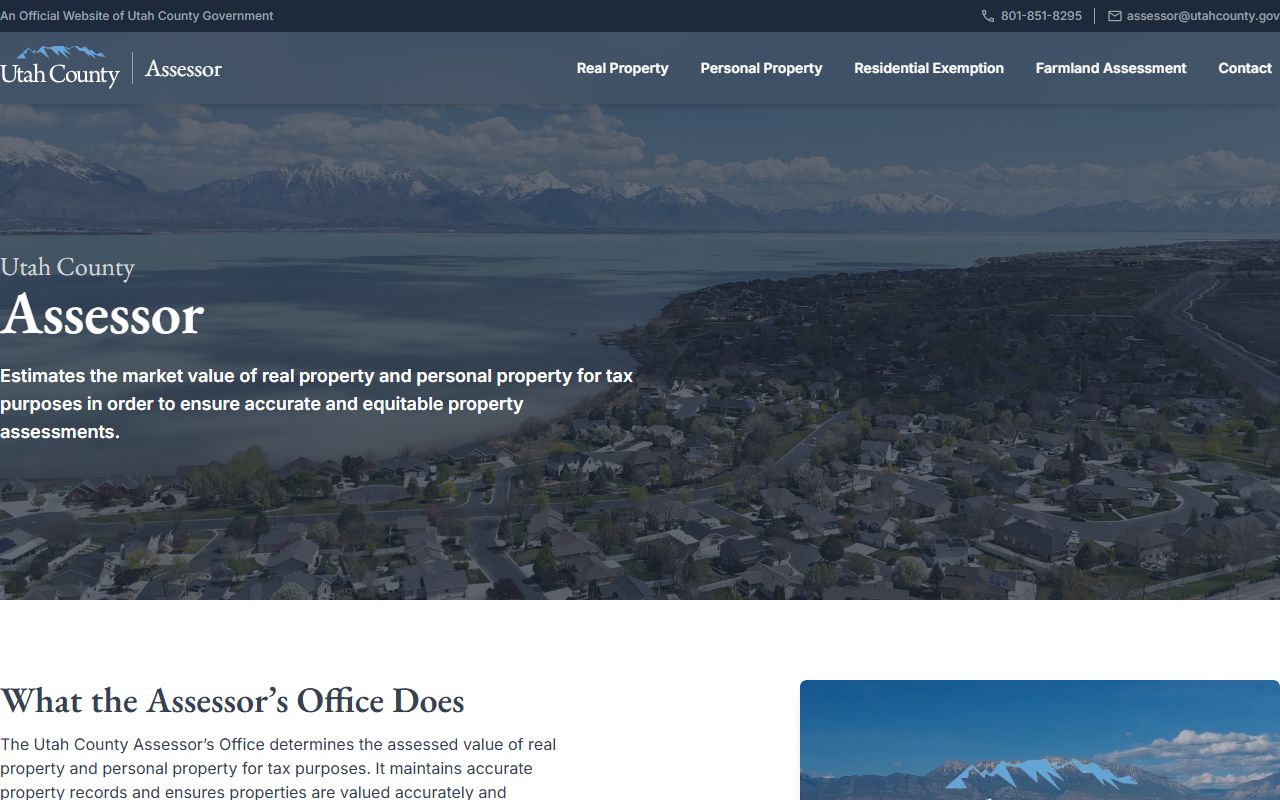 The Assessor's parcel search lets you find current assessed values, ownership information, and property classification data for Utah County properties by address or parcel ID.
| Office |
Utah County Assessor 100 East Center Street Provo, UT 84606 Phone: (801) 851-8179 |
|---|---|
| Website | utahcounty.gov/Dept/Assessor |
The Utah State Property Values tool at propertyvalues.utah.gov is another option for pulling Utah County assessment data. The statewide portal covers all 29 Utah counties and lets you look up values without going through the county's own site. It is a good first stop when you need a quick value check or are comparing Utah County parcels to properties in other counties.
Utah County Treasurer and Tax Records
The Utah County Treasurer collects property taxes and maintains payment records for all parcels in the county. You can look up current tax balance, payment history, and delinquency status online through the Treasurer's portal at utahcounty.gov/Dept/Treasurer. A clean tax check is a standard step before buying any Utah County parcel, since unpaid taxes become a lien on the land that follows ownership.
The Utah County Treasurer's tax portal at utahcounty.gov/Dept/Treasurer shows current tax balances, payment history, and delinquency status for Utah County parcels.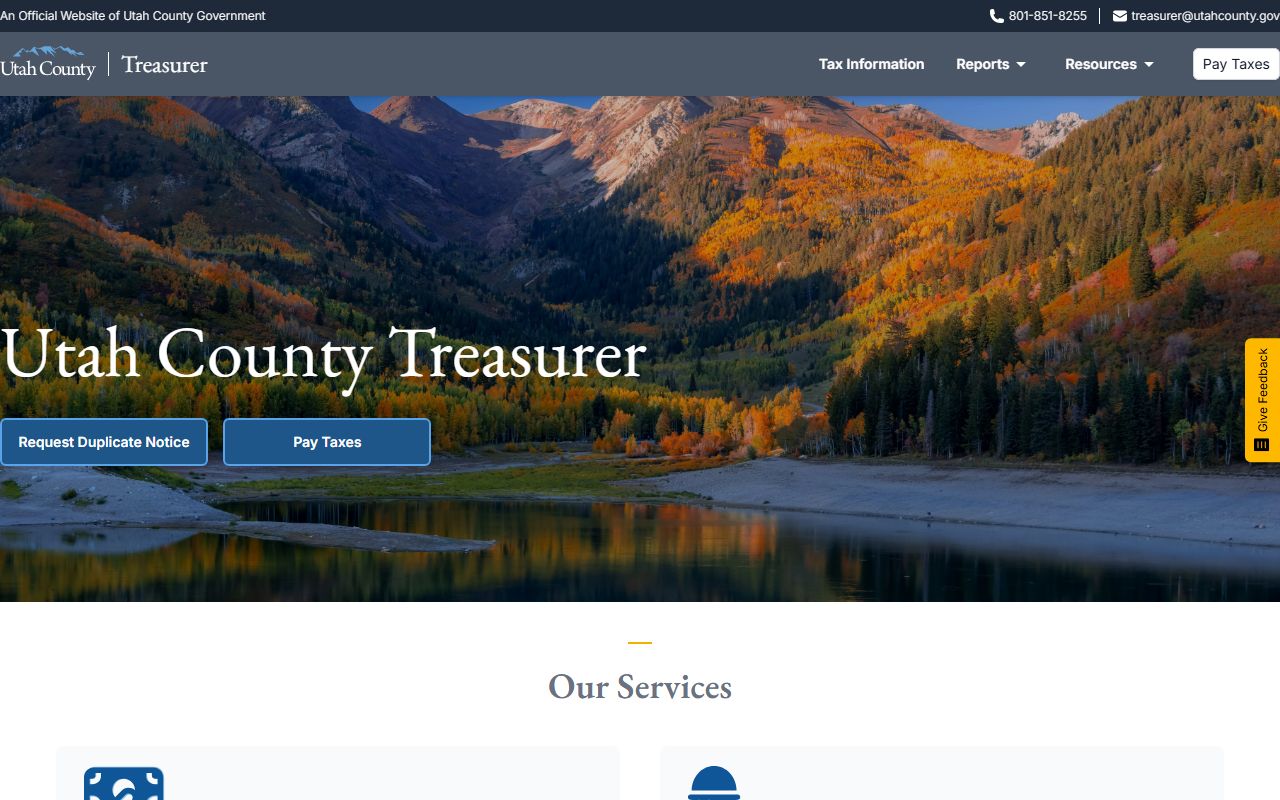 Searching tax status through the Treasurer's portal is a fast way to check whether a Utah County parcel has outstanding balances before closing a purchase or lien search.
Property tax appeals in Utah County go through the county Board of Equalization. If you believe your parcel has been assessed at more than its fair market value, you can file an appeal with supporting documentation. The Board reviews the Assessor's valuation and determines whether a reduction is appropriate. Contact the Assessor's office for current appeal deadlines, since they are tied to the annual assessment cycle and missing the filing window closes the option for that tax year.
Property Watch Fraud Alert Service
Utah County offers a free Property Watch service at property-watch.utahcounty.gov. When you register a parcel, the system sends you an email notification any time a new document is recorded against it. This is a practical fraud prevention tool. Property deed fraud through unauthorized filings is a growing concern nationally, and Property Watch lets Utah County property owners know right away when a new deed, lien, or other instrument hits their parcel in the Recorder's index.
The Utah County Property Watch service at property-watch.utahcounty.gov sends free email alerts whenever a document is recorded against a registered Utah County parcel.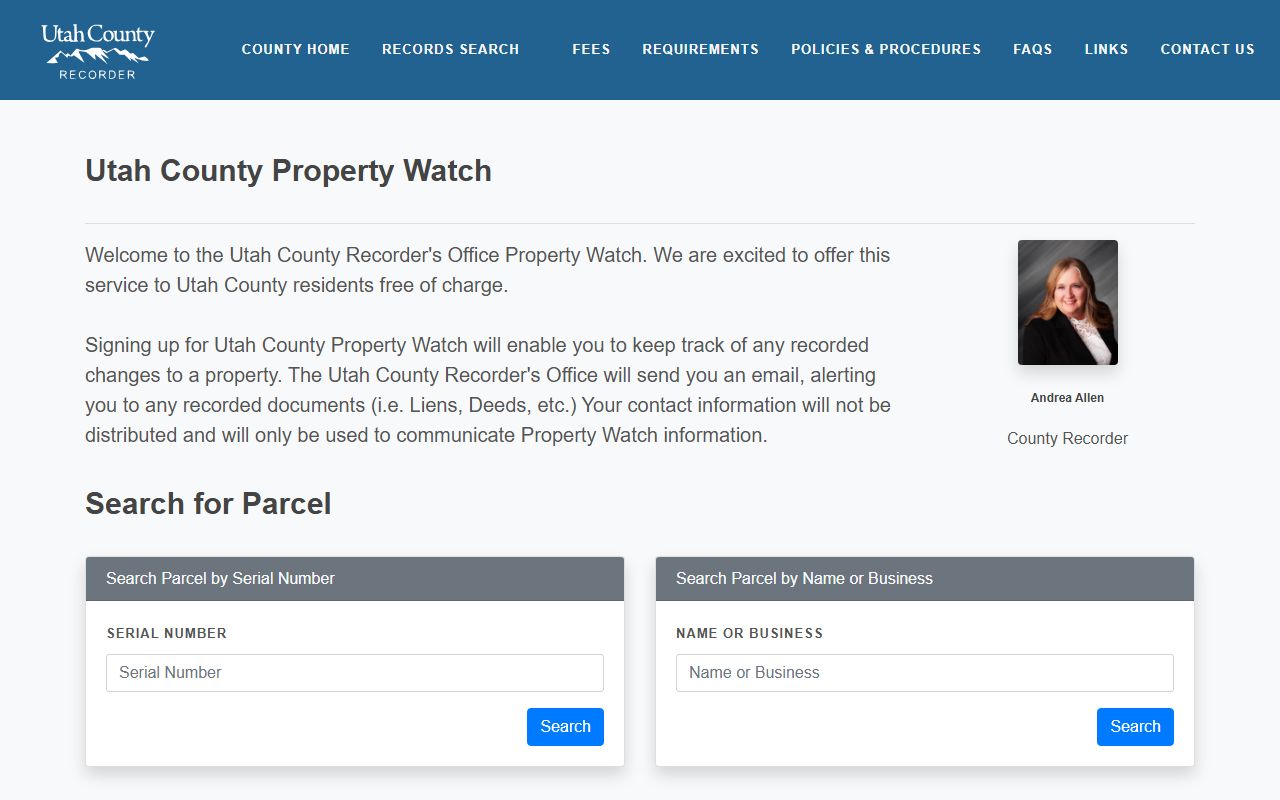 Setting up Property Watch on your Utah County parcels is free and takes only a few minutes through the county portal.
Property Watch is a monitoring service, not a search tool. You set it up once and let it run. It complements the Land Records Portal: use the portal for active searching, and use Property Watch to catch anything new as it hits the index. For owners with multiple Utah County parcels, you can register each one separately to get individual alerts per parcel. This is useful for landlords, investors, and anyone who owns property in multiple parts of the county.
GIS Parcel Data and Mapping
The Utah Geospatial Resource Center at gis.utah.gov maintains statewide parcel data including Utah County boundary files, parcel maps, and downloadable GIS datasets. The portal lets you view parcel lines and attributes, identify neighboring parcels, and download spatial data for use in research and mapping projects. This is a useful supplement to the Recorder's document index when you need to see where a parcel sits physically, not just what documents are recorded against it.
Utah County itself also provides GIS mapping tools through the county website. These local tools are often more detailed than the statewide portal for Utah County specifically, and they may integrate directly with the Assessor's parcel data for a combined view of ownership, value, and location. Check the county's GIS resources at utahcounty.gov for current tools available to the public.
GRAMA Requests and Public Access
Utah's Government Records Access and Management Act, Utah Code § 63G-2, classifies most Utah County property records as public. Any person can inspect recorded instruments at the Recorder's counter without stating a reason. You can review deeds, liens, plat maps, and other recorded documents for free. Fees apply only when you want paper or digital copies.
Utah County offers a GRAMA Request Portal online for submitting formal records requests electronically. This is useful for bulk requests or when you need records that are not available through the standard public search portals. The portal tracks your request and provides status updates without requiring a trip to the county building. GRAMA gives Utah County 10 business days to respond. For complex requests, the office may extend that timeline but must notify you in writing. Denials must cite the legal basis under GRAMA. For standard property records, denial is rare since recorded instruments are public documents by definition.
Historical Property Records
The Utah Division of Archives at archives.utah.gov holds historical land records for Utah County dating back to the mid-1800s. This includes early deed books and recorded instruments that predate the county's modern electronic systems. For chain of title research on older parcels in Provo, Springville, American Fork, or other Utah County communities, the Archives may have records not available through the county's online portal.
The Fourth District Court in Provo handles civil cases that affect real property in Utah County, including judgment liens, foreclosure actions, probate cases, and quiet title suits. A judgment entered by the Fourth District Court can become a lien on all real property owned by the judgment debtor in Utah County once recorded with the Recorder's office. Searching both the Recorder's index and court records gives a complete picture of any encumbrances on a Utah County parcel. Court records are accessible through the Utah Courts XChange system at utcourts.gov.
Recording Laws and Title Protection
Under Utah Code § 57-3-101, recording a document with the Utah County Recorder gives constructive notice to all future buyers and lenders. Once a deed, lien, or easement is in the Recorder's index, the law treats everyone as having seen it. This is the foundation of Utah County's entire recording system and the reason title companies search the index before insuring any transaction. A buyer who skips a title search can still be bound by prior recorded claims they never actually looked up.
Utah is a race-notice state. In a priority dispute between two competing claimants to the same Utah County parcel, the one who recorded first and had no actual knowledge of the other's prior unrecorded claim generally wins. That rule makes prompt recording critical after closing in Utah County. Delay creates a window where a competing instrument could be filed first. In one of Utah's fastest-growing counties, where transaction volume is high, that window is not theoretical. Record your deed or trust deed as soon as the closing is complete.
Recording requirements for Utah County follow Title 57, Chapter 3 of the Utah Code and the Recorder's duties under Title 17, Chapter 21. Documents must meet formatting standards, include the correct legal description, and carry the required signatures and notarization before the Recorder will accept them for the official index.
Cities in Utah County
Utah County includes some of Utah's fastest-growing cities. All property records for parcels in these cities are recorded with the Utah County Recorder in Provo. City offices may maintain local building and planning records, but the county is the official custodian of all recorded property instruments.
Nearby Counties
Utah County borders Salt Lake, Wasatch, Juab, and Sanpete counties. For parcels near a county line, confirm the correct recording jurisdiction in the legal description before requesting records from Utah County.