
South Jordan Property Records
South Jordan property records are maintained by the Salt Lake County Recorder, not the city itself. When a deed is signed, a mortgage is placed, or a lien is filed on a South Jordan property, that document goes to the county recorder in Salt Lake City. This page explains how to search South Jordan property records online, what the Salt Lake County system provides, and what South Jordan city offices handle separately for permits and land use. South Jordan has grown quickly over the past two decades and now has around 80,000 residents across a mix of newer subdivisions and commercial corridors.
South Jordan Quick Facts
Salt Lake County Recorder Holds South Jordan Records
South Jordan is in Salt Lake County, so all property deed records for South Jordan addresses are filed with the Salt Lake County Recorder. This includes deeds of trust, warranty deeds, quit claim deeds, mechanic's liens, lis pendens, and any other instrument affecting title. The city government does not hold deed records and cannot provide copies of them.
The Salt Lake County Recorder is at 2001 South State Street, Suite N1-600, Salt Lake City, UT 84114-4575. You can call (385) 468-8145 or visit their website at slco.org/recorder. The online portal allows free access to document searches and parcel data. Certified copies cost extra, and you should call ahead to confirm current fees before requesting them. In-person visits are available during normal business hours.
| Office | Salt Lake County Recorder |
|---|---|
| Address | 2001 South State Street, Suite N1-600 Salt Lake City, UT 84114-4575 |
| Phone | (385) 468-8145 |
| Website | slco.org/recorder |
Utah Code § 57-3-101 says that recording a document at the county recorder's office gives constructive notice to the world. For South Jordan property owners, this is the legal mechanism that makes ownership publicly known. An unrecorded deed can be defeated by a later buyer who had no notice and recorded their deed first, a situation the race-notice rule under § 57-3-102 is designed to govern.
Searching South Jordan Property Records Online
The Salt Lake County Recorder's online portal at slco.org/recorder is the main tool for searching South Jordan property records. You can search by grantor or grantee name, parcel number, or legal description. The index goes back many years and includes deed images you can view online. Most searches are free; fees apply for certified copies or printed documents.
The Salt Lake County Assessor at slco.org/assessor is a key second step. The assessor holds ownership records, assessed values, parcel maps, and exemption data for every South Jordan parcel. If you want to see who owns a property right now or what it was last assessed at, the assessor's portal is faster than the recorder for that purpose. The assessor can be reached at (385) 468-8000.
Salt Lake County's Property Watch service at slco.org/data-services/PropertyWatch lets South Jordan property owners sign up for free alerts when any document is recorded against their parcel. Given the pace of growth in South Jordan and rising property values, this is a useful tool to have in place. Deed fraud is a real concern, and early detection is the best defense.
The Utah property values portal at propertyvalues.utah.gov aggregates assessor data statewide. It is a convenient way to compare assessed values across South Jordan and neighboring cities without navigating multiple county systems.
Salt Lake County Property Watch Program
The Salt Lake County Property Watch portal lets South Jordan homeowners register their parcel and receive email alerts when a new document is recorded. The screenshot below shows the program's enrollment page at slco.org/data-services/PropertyWatch. This is a free service with no ongoing cost.
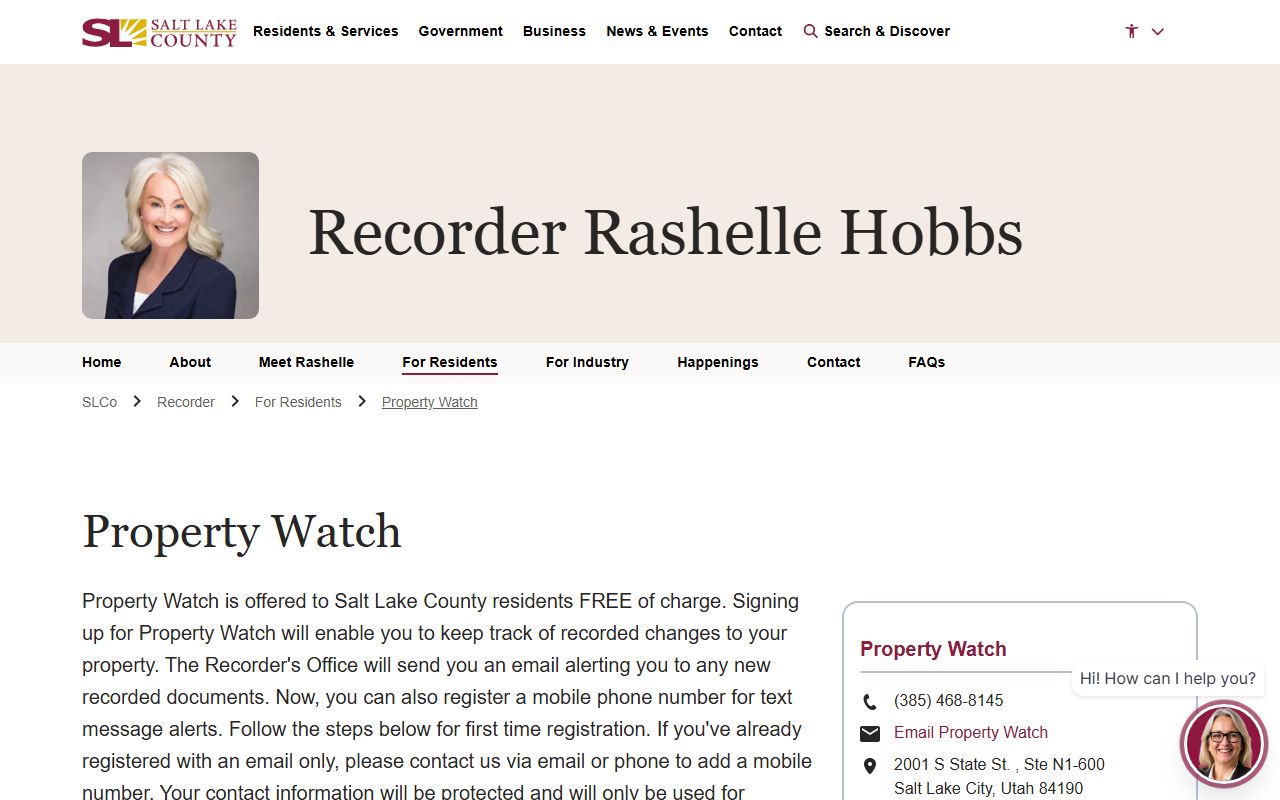
Signing up for Property Watch is one of the easiest steps a South Jordan homeowner can take to protect against unauthorized deed transfers or fraudulent encumbrances.
South Jordan City Resources for Property Research
South Jordan city government manages permits, planning approvals, and zoning for properties within city limits. These records are separate from the county deed system but are essential for a complete picture of any South Jordan property. If a home has been expanded, a garage added, or a lot split, those approvals exist at the city level.
South Jordan's Building Division issues permits for construction and renovations in the city. Permit records help you verify that work on a South Jordan property was done legally and passed inspections. City permits are not recorded with the county recorder and will not show up in a deed search. To look up permit history, contact South Jordan city government directly. Their main website is a starting point for locating the building services and planning departments.
The Planning Division at South Jordan City handles zoning, subdivision approvals, and land use decisions. Zoning affects what you can build and how you can use a parcel. For properties near the city's newer commercial areas or in areas that have seen recent development, a quick check with the planning department can clarify what is allowed and what has been approved nearby.
Note: South Jordan city records for permits and planning are maintained separately from Salt Lake County deed and assessment records. Both sources are needed for full property due diligence.
Historical Property Records for South Jordan
South Jordan's history as a farming and residential community means its older land records go back to the early settlement period. The Salt Lake County Recorder holds the complete recording history. Older records are on file and many are indexed online, though some very early instruments may require an in-person visit to review physical index books.
The Utah Division of Archives at archives.utah.gov holds historical state records that may supplement county records for South Jordan parcels with long ownership chains. For parcels that were originally part of federal land grants or homestead entries, federal records through the Bureau of Land Management are also worth checking. Utah's GIS portal at gis.utah.gov provides parcel map layers with historical overlays useful for boundary research.
Recording Laws and Access Rights in South Jordan
Utah property records are public under GRAMA, Utah Code § 63G-2. You can access deeds, mortgages, and liens recorded at Salt Lake County for any South Jordan parcel. The Salt Lake County Recorder may charge fees for copies but cannot deny access without cause. GRAMA also gives you the right to appeal a denial through the State Records Committee.
The state's title recording system makes South Jordan property records open by design. Transparency in land ownership is a core function of the county recorder system. When you search a South Jordan parcel's history, you are using a system built to be public and permanent. That same transparency protects you as a buyer or owner, since any competing claims that were not recorded are legally weaker than yours once you file.
Tax records are also public. The Salt Lake County Treasurer handles property tax payments and delinquencies for South Jordan parcels. A tax lien can affect title and should be checked as part of any title search. Confirm current tax status before closing on any South Jordan property.
Salt Lake County Property Records
South Jordan is in Salt Lake County, and all South Jordan deed and property records are on file at the Salt Lake County Recorder. Visit the county page for detailed information on the recorder, assessor, treasurer, and all search tools.
Nearby Utah Cities
South Jordan shares the Salt Lake County Recorder with several nearby cities. Select a city below to find property record resources for that area.